
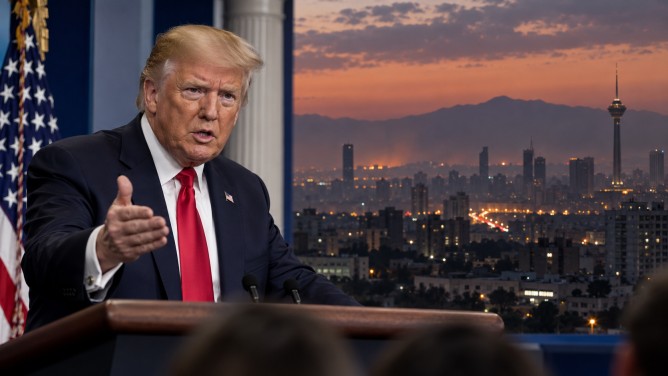
US President Donald Trump has cautioned that the United States may further increase its military operations against Iran, underscoring Washington’s commitment to prevent Tehran from acquiring nuclear weapons. This warning comes amid Iran’s threats to expand its retaliatory measures against military facilities and civilian infrastructure in neighboring West Asian countries if the US and Israel resume their strikes.
Trump, addressing reporters on Thursday, emphasized that the United States had already significantly undermined Iran’s military capabilities but hinted at the possibility of additional actions. He expressed optimism about the conflict’s resolution, predicting a subsequent decline in oil and gasoline prices.
The ongoing conflict, which erupted in late February, has escalated tensions across West Asia and disrupted the vital maritime passage through the Strait of Hormuz, crucial for global oil and gas transportation. Attacks targeting shipping and energy infrastructure have heightened concerns over regional security and international energy security.
Iran has indicated that any renewed attacks by the US and Israel could provoke retaliation against American military installations, airports, pipelines, and other civilian sites in neighboring countries, according to media reports. Earlier in the conflict, Iranian strikes reportedly inflicted damage on US military and diplomatic facilities, including those in Bahrain, and impacted energy and industrial sites in the United Arab Emirates and Qatar, as well as airports in Dubai, Kuwait, and Bahrain.
Iranian Foreign Minister Abbas Araghchi has cautioned that further military actions could jeopardize civilian lives, regional stability, and the global economy. The potential for expanded attacks has raised alarms among regional governments already confronting security challenges and infrastructure disruptions.
Military analyses suggest that Iran maintains a robust ballistic missile arsenal and might be attempting to reestablish some production capabilities using existing components and subterranean facilities. Meanwhile, the United States, Israel, and regional allies are experiencing pressure on their stocks of air-defense interceptors amid ongoing security threats.
Efforts to broker peace remain at a standstill, with the disruption around the Strait of Hormuz continuing to threaten global energy markets and commercial shipping. Trump’s warning of potential further military action and Tehran’s threat of broader retaliation add to the uncertainty surrounding the conflict’s next phase, which could have significant repercussions for regional security, civilian infrastructure, and international oil prices.
