
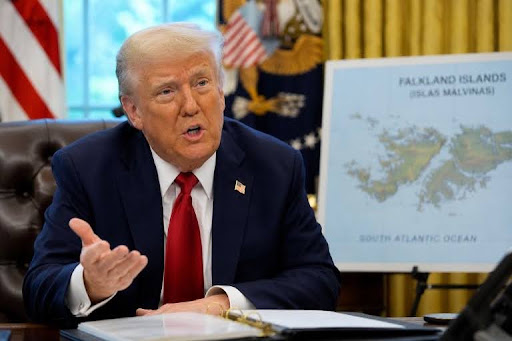
In a move that could potentially strain US-UK relations, Donald Trump has suggested he might be re-evaluating the United States’ traditional support for Britain’s claim over the Falkland Islands. When questioned by reporters about whether the US position on the South Atlantic territory was being reconsidered, Trump mentioned that he routinely reviews all stances, labeling this as just one among many. While the US officially maintains a neutral stance on the sovereignty dispute between Britain and Argentina, it has historically acknowledged British administration of the islands, which have been under British control almost continuously since 1833, except for the brief 1982 conflict following an Argentinian invasion.
Trump’s remarks are widely interpreted as an indication that his administration might leverage the Falklands issue to pressure the new British government, led by Prime Minister Andy Burnham, into increasing defence spending and contributions to NATO. A spokesperson for Burnham emphasized that Britain remains steadfast in its position, highlighting that the islanders identify as British, desire to remain a UK overseas territory, and affirming London’s commitment to fulfilling its international defence obligations. These comments come in the wake of a report quoting an anonymous US official suggesting that Washington might alter its stance if Britain does not meet its defence spending targets.
This development occurs amid speculation that the UK’s chancellor could reduce a previous commitment to elevate defence spending to 3% of GDP by 2030, ahead of an upcoming budget announcement. Pressuring allies to augment defence spending has been a consistent element of Trump’s foreign policy across both of his presidencies. Allies had previously agreed to elevate defence and security expenditures to 5% of GDP by 2035. Rumors of a potential US policy shift on the Falklands have circulated for months, following a leaked Pentagon document that reportedly proposed reviewing Britain’s claim due to disagreements over the Iran conflict.
A shift in the US stance would carry considerable symbolic significance. During the 1982 Falklands War, robust US diplomatic support bolstered Britain’s military efforts to reclaim the islands after Argentina’s invasion, a conflict that resulted in numerous casualties on both sides and helped solidify a close political alliance between the nations’ leaders at the time. In recent years, Trump has cultivated a close relationship with Argentina’s president, who has vocally backed Argentina’s claim to the islands. Trump has previously approved substantial financial aid to Argentina, contingent on political developments there, and later relaxed trade restrictions on Argentinian beef imports.
Amidst these diplomatic maneuvers, a 2013 referendum reflected overwhelming support among Falklands residents for remaining under British rule. Tensions surrounding the issue resurfaced following a politically charged gesture by Argentinian players after a sporting event, which resulted in a fine from football’s governing body.
